Krásna Hôrka Castle
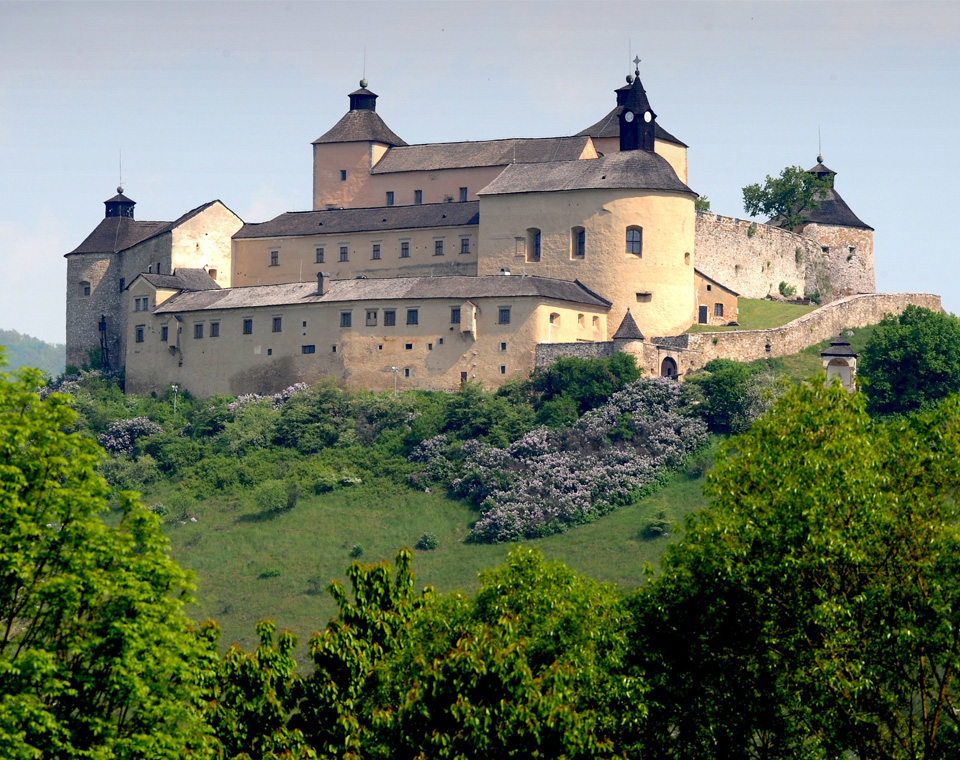
Krásna Hôrka Castle
History of the castle
Krásna Hôrka is the only Slovak castle whose architecture and collections have been preserved almost intact. The castle had mainly a protective and administrative function and only marginally a residential function. The appearance of its architecture was influenced by the reconstructions up to the first half of the 18th century and its character of a country residence with a pleasant atmosphere was determined by a kind of picturesque neglect and romantic interventions during the 19th century. By the end of the 17th century, the owners' attitude to their ancestral castle can be described in today's terms as nostalgic.
Therefore, quite soon, after 1850, the Andrássy family decided to transform Krásná Hôrka into a museum. Krásná Hôrka therefore did not remain in the consciousness as a military fortress (the Battle of Rožňava in 1556 took place near it, and the castle was also a military centre at the time of the Estates' uprisings), nor as a pompous representative residence, but as a family memorial, where relics of the ancestors and the ancient past were collected and stored. Paradoxically, the castle fulfilled its representative function (except for a short period of František Andrássy around 1740) in the 19th century, when members of the Andrássy family proudly showed it off to their political and business partners and distinguished visitors. Beautiful Hôrka fulfils rather romantic ideas of a castle, drawing partly on the Renaissance and Baroque court culture of the nobility.
The material composition of the castle is an excellent example of how the castle grew and expanded over the centuries - from the first buildings of the castle complex on the highest point of the cliff to the architecture unrelated to its original function in the forebrake. The origins of the castle date back to the turn of the 13th and 14th centuries, and their traces are hardly legible today under the accretions of other periods. Krásná Hôrka is therefore more of a Renaissance castle than a medieval one, thanks to the extensive building modifications carried out by the Bebeks in the 16th century and by Mikulas Andrássy in the 17th century. After the death of Žofia Seréda in 1710, her son František and his wife Kata Keresztes began to build a Baroque nobleman's court. Apart from the negligible building activity, the more significant works are those whose creation was apparently motivated by the patron's deep piety.
19th century
Under František Andrássy the first gate with monumental sculptural decoration of saints, the chapel of St. John of Nepomuk in front of the castle, a baroque (probably) trinity column (now torsion) and several paintings with religious motifs were built. Apparently, the spread of the cult of the Virgin Mary, to whose Assumption the castle chapel was later dedicated, can also be attributed to this period. It was probably in this period that the so-called gardens were created in the courtyards, which were created by bricking up the growth rock. At the end of the 18th century, due to the growing cult of the Madonna of Beaumont, the Andrássy family had the old chapel (on the site of the southern artillery bastion) from the time of Francis rebuilt into a more spacious church with richly decorated murals and a choir leading into the former residential wing of the central castle.
One of the interesting stages in the modern history of the castle is the period after the fire at the beginning of the 19th century. The widow of Stephen III, Countess Maria Festetich, had the castle repaired and even moved into its rooms (in the central castle). She furnished and decorated the rooms with the works of Josef Caucik and Henri Cavet. It was these rooms that formed the basis for the creation of the family museum, which the Andrássy family called the 'régiségtár'. The first mention of Krásná Hôrka being a museum dates back to 1857. On the basis of one of the family agreements, Krásná Hôrka was designated as the final resting place of the members of the family. At the end of the 1890s, Count Dionýz Andrássy entrusted Gy. Czigler from Budapest to rebuild the cellars of the central castle and to make minor alterations to the courtyards. At that time, a staircase with wrought-iron railings was built, which connected the 'honour' courtyard and the park area, where a unique neo-Gothic chapel was built in 1828. In the same period, the unique Francis Museum was created, which commemorates the wife of the last male descendant of the younger branch of the family.